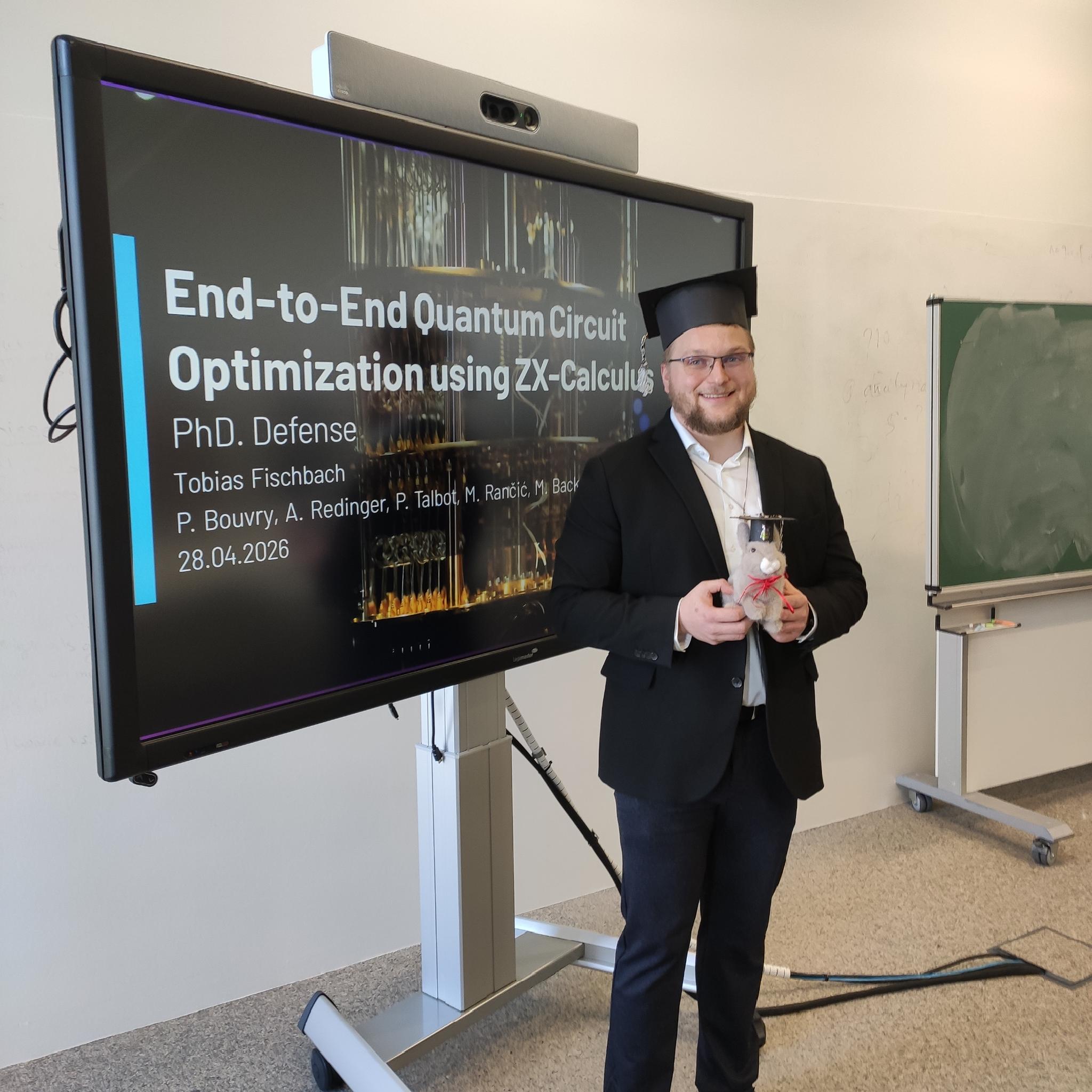
PhD Defense: End-to-End Quantum Circuit Optimization using ZX-Calculus
On the 28th of April 2026, I successfully defended my dissertation with the title End-to-End Quantum Circuit Optimization using ZX-Calculus [slides].
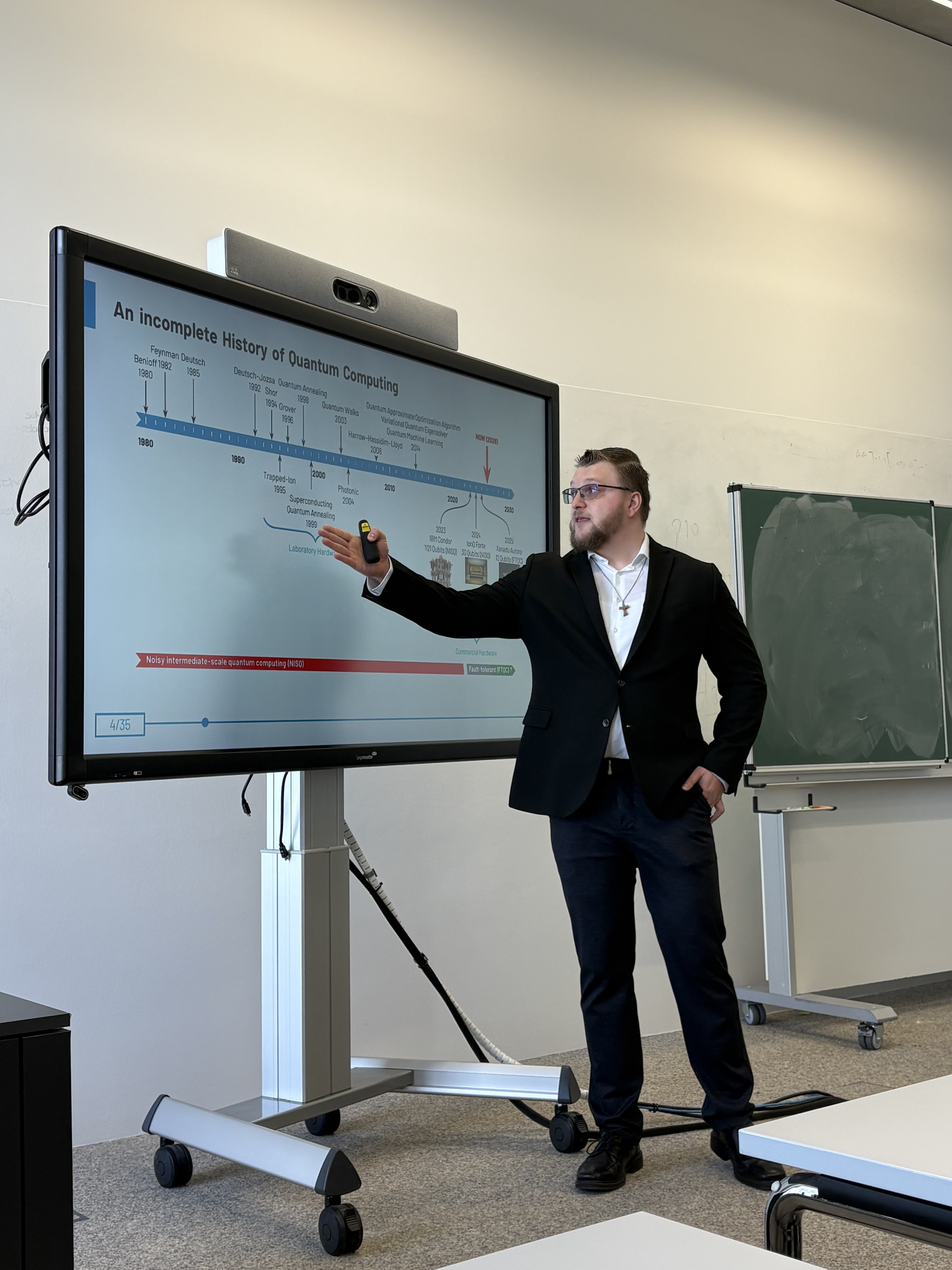
I would like to express my sincere gratitude to my supervisor Prof. Dr. Pascal Bouvry and advisor Dr. Pierre Talbot. They were the grindstones to sharpen my mind. A special thanks to Prof. Dr. Alex Redinger who joined my CET and always offered valuable advise. Furthermore, I would like to thank all my team members in the Parallel Computing and Optimisation . Lastly, a special thanks to my dissertation committee: Prof. Dr. Marko Rančić, Dr. John van de Wetering, Dr. Miriam Backens. I would also like to express my gratitude to all the other people who accompanied me along this journey.
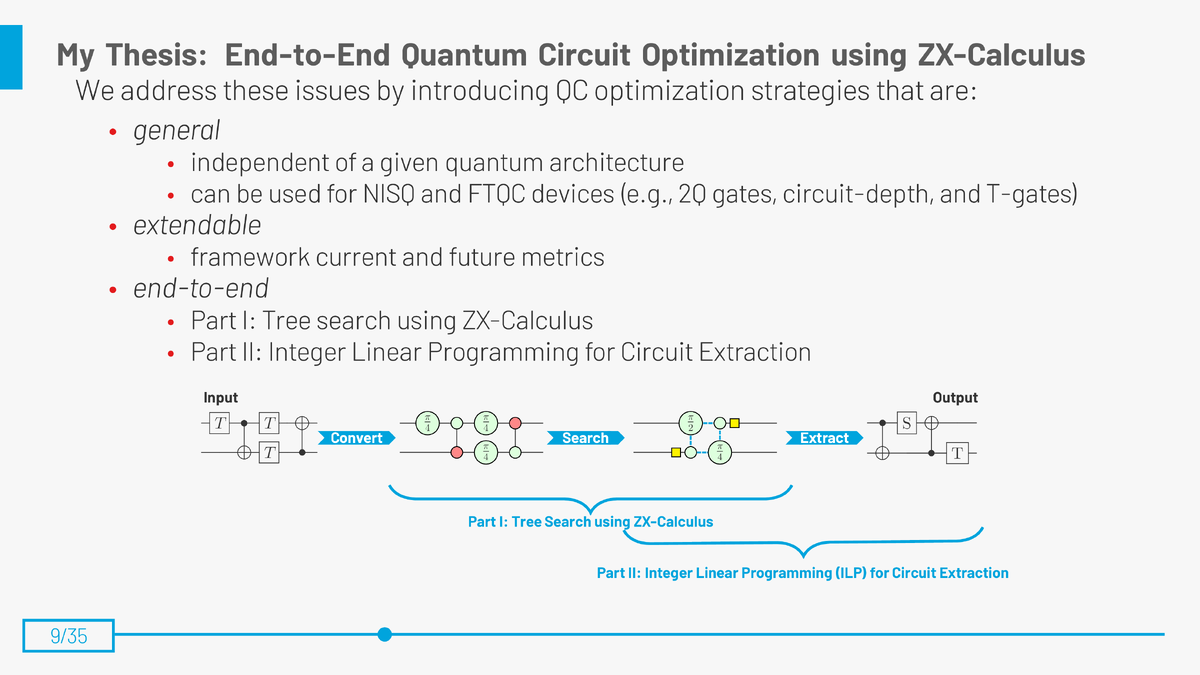
My thesis establishes a ZX-based end-to-end pipeline for quantum circuit optimization that leverages tree search for metric-agnostic ZX-diagram optimization and integer linear programming (ILP) paired with backtracking search to improve the circuit extraction step. The contributions of my thesis are four-fold:
- First, it presents a comprehensive survey of ZX-based quantum circuit optimization, categorizing existing approaches by the employed optimization strategy, the target metric, and the intended quantum computing architecture.
- Second, this work formalizes the ZX-diagram optimization problem as the explicit state-space exploration of rewriting rule sequences.
- Third, the formal approach is put into practice by implementing tree search algorithms, in particular depth-first search (DFS), iterative deepening depth-first search (IDDFS), and limited discrepancy search (LDS), to reduce the T-gate and edge count of ZX-diagrams. Furthermore, the efficacy of different pruning conditions is investigated. Lastly, the novel local-elimination (LE) method is introduced as a metaheuristic to select growing sub-ZX-diagrams around a target spider. Instead of performing tree-search optimization on intractably large ZX-diagrams, local-elimination changes one large optimization problem into a sequence of tractable small searches. All tree search strategies are extensively tested on benchmark data sets that contain different quantum circuit types.
- Finally, my work improves two-qubit gate count during circuit extraction by introducing an integer linear programming model that replaces the Gaussian elimination (GE) steps present in current circuit extraction algorithms. Pairing the integer linear programming model for circuit extraction with backtracking allows the exploration of multiple solutions that take advantage of gate commutation and cancellation rules during extraction.